Homesick for Somewhere You've Never Slept: The Strange Grief of the Eastern European Diaspora Kid
The Photograph on the Mantel
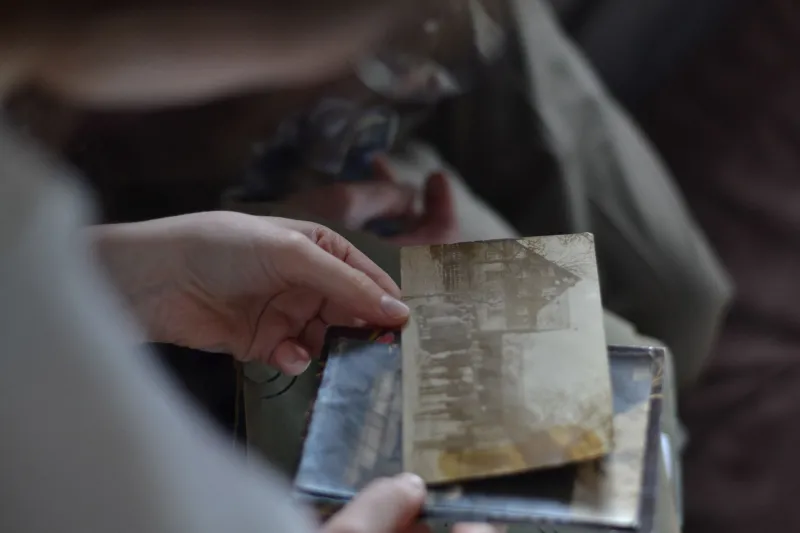
There's a photograph in a lot of Eastern European immigrant homes — faded, slightly formal, people standing in front of a building that doesn't exist anymore or a landscape that's been completely transformed. The children and grandchildren of those immigrants grow up with that photograph as a kind of portal: evidence of a life that was lived somewhere else, evidence of a self that existed before the version of the family that made it to America.
For a lot of diaspora kids, that photograph becomes an obsession.
Not always consciously. It might show up as an unusual interest in the language their parents spoke at home and then stopped speaking. As a pull toward certain foods, certain aesthetics, certain ways of arranging a room or greeting a stranger. As a feeling, hard to articulate, that some part of their identity is located somewhere they've never been — or been to once, as a child, without the context to understand what they were seeing.
This is the particular grief of the second and third generation: homesickness for a place that was never yours, for a life you never lived, for a version of yourself that could only have existed if history had gone differently.
Inherited Memory Is a Real Thing
Researchers have a term for the stories and emotional residue that pass between generations: postmemory. It was coined by scholar Marianne Hirsch to describe the relationship that children of trauma survivors have with experiences they didn't personally live through but that have shaped them as thoroughly as if they had.
For Eastern European diaspora families — many of whom carry histories involving war, displacement, Soviet repression, or the chaos of post-communist transition — postmemory is often the water they swim in. The stories aren't always told directly. Sometimes they come through as anxiety, as certain silences, as the way a parent reacts to news from the old country, as the particular weight that falls over a dinner table when someone mentions a city or a year.
Children absorb this. They build internal maps of places they've never been, populated by characters they've never met, organized around events that happened before they were born. And then, at some point, usually in their teens or twenties, they start to wonder what it would feel like to stand in those places and see if the map matches the territory.
The TikTok Generation Goes Looking
What's interesting about this phenomenon right now is how it's playing out online. Eastern European diaspora identity — Polish-American, Ukrainian-American, Romanian-American, Bulgarian-American — has had something of a cultural renaissance in the past few years, driven largely by younger people who are using social media to excavate, share, and celebrate heritage they feel slipping away.
The content ranges from the intensely personal ("things my babcia used to say") to the broadly aesthetic (Eastern European brutalist architecture, Soviet-era design, folk embroidery patterns) to the explicitly political (solidarity with Ukraine, documentation of cultural erasure, debates about what Eastern European identity even means in an American context).
What unites most of it is a quality of longing. These aren't posts from people who have the thing and are showing it off. They're posts from people who are reaching for something they can sense but can't quite hold — a cultural inheritance that feels both deeply theirs and somehow just out of reach.
Anya, a twenty-four-year-old from suburban New Jersey whose parents immigrated from Belarus in the late 1990s, described it to me this way: "I grew up being embarrassed by the Eastern European stuff — the accent, the food, the way my parents were so different from my friends' parents. And then at some point I flipped completely. I started being obsessed with it. I wanted to learn Russian properly, I wanted to go to Minsk, I wanted to understand what my parents had actually left. It felt like there was this whole part of me I hadn't met yet."
The Trip That Doesn't Quite Resolve It
Many diaspora kids eventually make the trip. They go back to the ancestral city, the village, the neighborhood their family came from. And the experience is almost universally described in the same complicated terms: beautiful, strange, moving, and somehow not quite what they expected.
Because the place that exists is not the place that was described. Cities have changed. Buildings have been demolished or renovated. The bakery is a cell phone store. The apartment building is still there but the family's apartment has different people in it now, different curtains, different sounds. The country their grandparents left no longer exists in the form it existed then — politically, culturally, sometimes literally.
And the diaspora kid, standing in the city square they've been imagining for twenty years, realizes something important: the place they were homesick for was never a place. It was a story. A collection of images and emotions and second-hand sensory details that their family carried across an ocean and assembled into something that felt like a home.
That's not nothing. It's actually something quite profound. But it's different from the thing they thought they were looking for.
The Identity That Lives in the Hyphen
What many Eastern European diaspora kids eventually arrive at is a sense of identity that lives in the hyphen — Polish-American, Ukrainian-American, Romanian-American. Neither fully the thing their parents were, nor fully the American thing they grew up performing. Something in between, with its own particular textures and tensions.
This in-between place can feel like loss. But it can also feel like a specific kind of richness — the ability to move between two sensibilities, to carry the emotional memory of a history you didn't live while also being fully embedded in the culture you did grow up in.
The longing doesn't go away, necessarily. But it can transform. The pull toward the ancestral place becomes less about finding something you're missing and more about understanding something you already carry. The photograph on the mantel stops being a door and starts being a mirror.
Anya went to Minsk in 2023. She said it was nothing like she imagined and exactly what she needed.
"I didn't find what I was looking for," she said. "But I figured out what I was actually looking for. Which was just — to understand where I come from. And I think I do now. A little bit. Enough."