Suffering Is Not a Bug: The Eastern European Case Against the Self-Care Industrial Complex
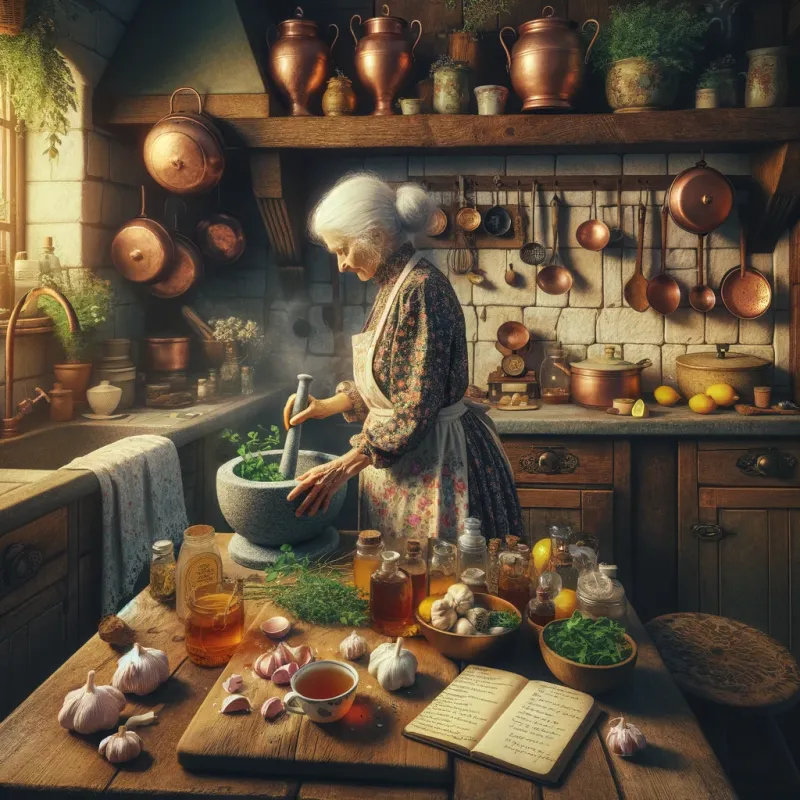
Photo: Eastern European grandmother kitchen tea herbal remedy cozy, via vitanews.fr
Let me describe a scene that will be familiar to roughly half the people reading this.
You're sick. Not hospital-sick, but properly miserable — fever, sore throat, the whole deal. You mention it to your Eastern European mother. She looks at you. She makes tea with something in it that smells like a forest floor. She says, in whatever combination of English and her first language she defaults to when unimpressed: "You'll be fine." And then she goes back to whatever she was doing.
No essential oil diffuser. No suggestion to "honor your body's need for rest." No Amazon cart filled with immune-support gummies. Just tea, a blanket, and the implicit understanding that you are expected to survive this.
Here's the thing: you always did.
The Wellness Industry Sold Us a Story
America has a $4.5 trillion global wellness market. That number is almost too big to mean anything, so let's make it smaller: it means there is an entire economy built around the premise that you are not okay and that fixing it requires purchasing something. A supplement. A meditation app. A weekend retreat in the Catskills where you journal about your inner child.
Eastern European immigrants, by and large, looked at this and said: absolutely not.
Not because they don't believe in taking care of themselves — they do, fiercely, in their own way. But because their definition of self-care was built in a context where resources were scarce, time was not a luxury, and the idea of paying someone to tell you to breathe deeply would have gotten you laughed out of the room. Resilience wasn't a workshop you attended. It was the baseline expectation for being a functional adult.
That sounds harsh. It was, sometimes. But it also produced something that no amount of self-optimization content seems to replicate: people who could actually tolerate difficulty without falling apart.
The "Just Deal With It" Ethos, Explained Without the Judgment
It's easy to mock the Eastern European approach to emotional and physical discomfort as repression, or toxic stoicism, or generational trauma that never got processed. And look — some of that criticism is fair. There are real costs to a culture that treats vulnerability as weakness and therapy as something only broken people need.
But there's a difference between suppressing what's hard and moving through it without making it the center of your identity.
Most Eastern European parents — and their kids, whether they admit it or not — operate on the second model. You acknowledge the difficulty. You don't pretend it isn't there. But you also don't build a lifestyle around managing it. You cook the food, you show up to work, you call your grandmother on Sunday, and somewhere in the doing of those things, the hard stuff gets metabolized.
It's not glamorous. It doesn't photograph well. Nobody is going to write a Substack newsletter about it.
But it works.
Gen Z Is Quietly Noticing
Here's what's interesting: the generation that was supposed to be the ultimate consumers of wellness culture is starting to push back against it. Not loudly — Gen Z rarely makes noise about the things that actually matter to them — but visibly, if you're paying attention.
The "delulu" trend. The "girl dinner" era. The growing fatigue with therapy-speak that turned every mildly uncomfortable interaction into a trauma response. The viral moments where someone says, essentially, sometimes you just have to do the thing even when you don't feel like it, and millions of people quietly exhale because someone finally said it.
This isn't the same as the Eastern European model, exactly. But it's adjacent to it. It's a generation that was sold the idea that optimizing their inner life would fix their outer one, and is now reckoning with the fact that it didn't.
Eastern European immigrants and their kids didn't need to be sold that lesson. They grew up in it.
The Real Power Move
Here's the nuance that gets lost in both directions of this conversation: knowing when rest is genuine recovery and when it's avoidance is actually a skill. And it's one that the Eastern European approach, at its best, teaches pretty effectively.
There's a difference between a bath that genuinely helps you decompress after a brutal week and a bath that you're taking because you don't want to deal with the email sitting in your inbox. There's a difference between therapy that helps you understand a pattern that's actively harming your life and therapy that becomes a way to indefinitely defer the changes you know you need to make.
Eastern Europeans, shaped by scarcity and pragmatism, tend to have a finely tuned radar for the second version of both. Not because they're enlightened, but because they couldn't afford to indulge it.
The irony is that this makes them, in some ways, better at actual self-care than the culture that invented the term. They know what genuine rest looks like because they've earned it. They know what recovery requires because they've had to do it without infrastructure.
What This Isn't
This is not an argument that suffering is good for you, or that Eastern European stoicism is superior to American emotional literacy, or that therapy is a scam. None of those things are true.
It's an argument that the commodification of wellness — the transformation of rest and recovery into a consumer identity — has made it genuinely harder for people to distinguish between what they need and what they've been sold.
And that sometimes the most radical thing you can do in a culture that wants to monetize your discomfort is to look at it, make the tea, put on the blanket, and trust that you'll get through it.
Your Eastern European grandmother already knew this. She just didn't charge you for the session.