Borscht Is the New Sourdough: Why Eastern European Grandma Food Became a Gen Z Power Move
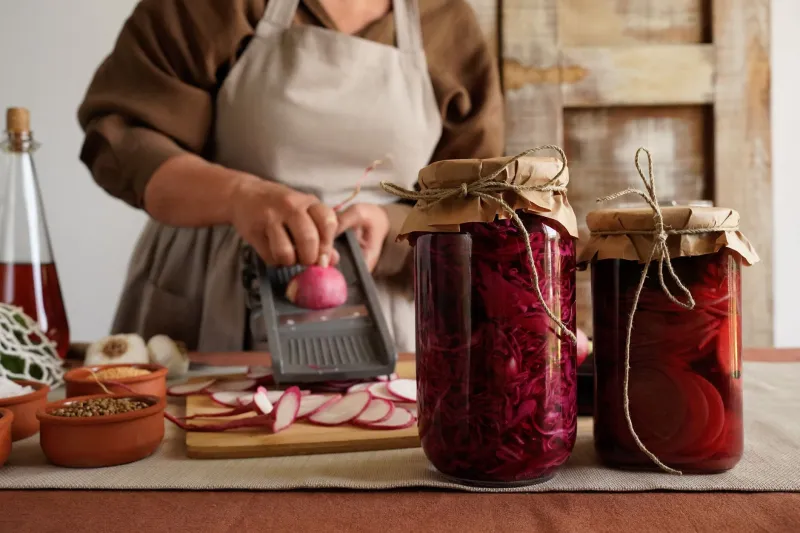
There's a jar of fermenting cabbage sitting on a windowsill in Kyiv. Another one in Łódź. Probably three more in Bucharest. And if you scroll TikTok long enough, you'll find one in a studio apartment in Brooklyn, too — tended by a 24-year-old who couldn't tell you where Ukraine is on a map but somehow knows exactly how much dill to add.
Something is happening with food. Not the kind of food that gets a Michelin star or a sponsored Instagram post — the other kind. The kind that takes three days, smells weird while it's working, and comes out tasting like something your great-grandmother would recognize. Eastern Europe has been doing this forever. But right now, in 2024, it feels less like tradition and more like resistance.
The Fast Food Hangover Is Real
Let's be honest about where we are. A generation raised on McDonald's value meals and delivery apps is quietly burning out on convenience. In Eastern Europe, the fast food wave hit later and harder — McDonald's opened in Moscow in 1990 to lines stretching around the block, a symbol of everything the West promised. For a while, processed and packaged meant modern. It meant you'd made it.
That story didn't age well.
Now, young Poles, Ukrainians, Romanians, and Czechs are turning back toward their kitchens with something that feels almost like urgency. Not because they're broke — though that's part of it — but because the alternative has started to feel hollow in a way that's hard to articulate. Convenience food doesn't ask anything of you. And increasingly, that feels like the problem.
"My mom stopped cooking traditional food when I was a kid because it was easier to buy things," says Marta, a 26-year-old graphic designer in Warsaw. "Now I'm the one calling my babcia to ask how to make żurek from scratch. It feels like reclaiming something we almost lost."
Fermentation as Philosophy
If there's one practice that sits at the center of this culinary revival, it's fermentation. Kvass. Kefir. Kimchi's Eastern European cousins — kapusta kiszona, ogórki kiszone. These aren't trendy additions to the menu. They're ancient technologies that Eastern European households maintained for centuries out of necessity and have now rediscovered as something closer to meditation.
The process is stubbornly slow. You cannot rush lacto-fermentation. You cannot optimize it with an app. You salt the cabbage, you pack it down, you wait. The bacteria do their work on their own timeline. For a generation that grew up with same-day delivery and infinite scroll, this is either maddening or deeply grounding — and a surprising number of young people are finding it to be the latter.
The mental health angle here isn't accidental. Therapists and nutritionists have been talking for years about the gut-brain connection, about how fermented foods feed the microbiome in ways that affect mood and anxiety. But the Eastern European relationship with these foods predates the science. Babcia didn't know about probiotics. She just knew that a jar of pickles on the table made winter survivable.
What American Gen Z Is Actually Borrowing
Over in the US, the sourdough moment of 2020 never really ended — it just evolved. The pandemic-era bread baking phase revealed something that surprised a lot of people: making food from scratch, slowly and with your hands, does something to your brain that ordering it doesn't. That discovery didn't go away when restaurants reopened.
American Gen Z, already skeptical of the processed food industry and increasingly anxious about what's actually in their food, has started looking outward for cooking traditions that prioritize real ingredients and time investment. Eastern European food — once dismissed in the US as heavy, beige, and vaguely Soviet — is getting a second look.
Borscht has been on Brooklyn menus for years, but now people are making it at home. Pierogi from scratch. Syrniki. Hunter's stew. YouTube channels run by Ukrainian and Polish home cooks are racking up American subscribers who follow along with zero connection to the culture but a genuine hunger for the approach: simple ingredients, long processes, nothing fake.
The appeal isn't just culinary. There's a vibe to Eastern European home cooking that resonates — unpretentious, unoptimized, slightly defiant toward the idea that food should be easy.
Cooking From Scratch as a Quiet Political Act
It would be an overstatement to call making soup a revolutionary act. But it would also be naive to pretend that food choices exist in a vacuum, especially for younger generations who've grown up watching multinational corporations shape what they eat, how they feel, and what they desire.
In Eastern Europe, the return to traditional cooking carries an extra layer of meaning. For countries that spent decades under Soviet rule — where food was standardized, scarce, and politically controlled — the preservation of regional recipes was always more than culinary. It was a way of keeping something alive that the system wanted flattened. A Ukrainian beet soup isn't just dinner. It's evidence of continuity.
That history gives the current revival a weight that American food trends sometimes lack. When a 22-year-old in Lviv posts her grandmother's holubtsi recipe on Instagram, she's not just sharing content. She's participating in an act of cultural transmission that her grandmother's generation fought to maintain.
The American version of this is different but not entirely disconnected. A Gen Z cook in Chicago who decides to learn their grandparents' recipes — whatever those happen to be — is making a similar choice: to push back against the convenience economy, to invest time in something that won't scale, to insist that some things are worth doing slowly.
The Kitchen as Counterculture
Here's the thing nobody expected: in a world where everything moves fast, knowing how to make something from scratch has become quietly radical. Not in an annoying, performative way — not the foodie flexing of the 2010s — but in a more grounded, private sense. The kitchen has become a place where the noise stops.
Eastern Europe figured this out early, maybe because it had to. When the outside world was unreliable — politically, economically, historically — the kitchen was where stability lived. The smell of something slow-cooking. The ritual of the same recipe, year after year. The jar on the windowsill doing its quiet, bacterial work.
Gen Z, East and West, is inheriting that lesson. Not because they read about it in a wellness blog, but because they're genuinely exhausted by the alternative.
Babcia was right. She usually is.